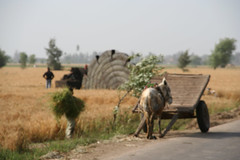
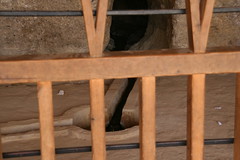
There were many of these water-wheels interspersed with deeper canals which criss-crossed the landscape. The water-wheels were used to drag water from the deeper channels onto the reclaimed land.
After some time travelling round sunesta and hotmellia couldn’t be bothered looking any further, and went for an Egyptian job costing $30. No Internet connection, hence no blogs for a couple of days.
Tourism
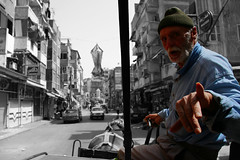
There isn’t much by way of tourism, but what is to be seen is easily taken in with one of the guides horse and carriage tours which last about 1 hr.
This took me to the bazar, past the military museum, which was closed, past the chapel of st. Eustice and a couple of mosques.
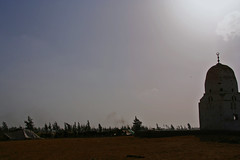
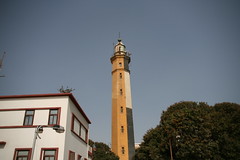
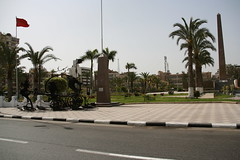
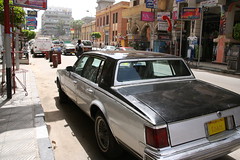
Here are a couple of shots of town to give you the idea.
Was fed by Ravens for over 10 years, a solitary raven brought St. Anthony, who lived to 105, half a loaf of bread each day until he died.
Background
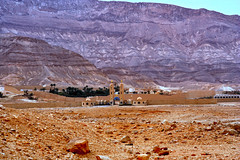
St. Anthony roamed the desert for many years until he came across this the site of the first monastic tradition, started firstly by Anthony the followed by Paul and supported by Ravens.
Monasteries originated from the cave dwelling monks converging on the desert springs.
Later walls were built around them and the cave dwellers came out from their caves to form small communities this was brought about mostly from the need from survival mostly from the elements but sometimes attacking Bedouins drove the monks together, where otherwise they would have had solitary lives.
These monasteries are the first in the world.
They are St. Paul’s and St. Anthony’s.
Visiting times
Visiting times are from 4am till 4pm.
There are 131 monks living at the monastery at present, much of the building dates back to the 13th century and some has been restored with the help of USAid project. Notably the Byzantine fresco’s in the chapel of the St. Anthony restored by Italian artists. Some of the fresco’s date back as far as 6th century.
From here you can visit the gardens, the gates and also the spring which supported so many monks.
The spring supports 400l of water each day. St. Anthony used to live in a cave 200m above this spring until St. Paul arrived, at which point many more monks came to the area. The spring was able to support them also.
You are able to drink the spring water which is kind of metallic with a hint of phosphorus.
Shop
At the end of the trip you are invited to buy from the shop. As I enter music is turned on to add to the buying ambience. I buy some honey, a bottle of monastic wine and a postcard of a particularly ugly nurse shark.
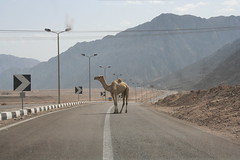
Camel strays onto the road near Nuweiba, a town made of a small beach chalets and a port which offers a grand vista as you descend from the approaching road.
Also known as Mount Horeb. It was here Moses witnessed the burning bush whilst tending Joseph’s flocks. ‘The bush burned but was not consumed’ is the common theme. There are different versions.
Sinai derives from the Semitic, Sin or ‘Sun God’ OR sin-ah, meaning hatred referring to the Jealousy people felt against the Jews. I’ve been to many places where the sun rises, and this isn’t the greatest amongst them.
Definitely a place for reflection.
Moses received the ten commandments here.
Ascent
Mount Sinai is a journey reachable from St. Katherine (town). Where there are a few hotels.
They say that Mount Sinai is best viewed at dawn, when one can wonder at the true spectacle of this desert mountain landscape and the beauty of it all etc. etc. The truth is, if you attempted in the day, you would suffer heat-stroke, exhaustion or both.
This is a 2 hour, 3 mile jaunt ascent of roughly 1500ft along dusty track followed by steps which last for 700 steps.
Expect to be fit or fast if you want to get there at dawn.
Descent Took the descent down the 7,000 step route.
This is the original, steep route, and the one we hear so much about. You will know you are on the right track as you pass through 2 arches.
It descends from the mountain taking in 7,000 rock hewn steps, although I didn’t count them so I can’t be sure where this statistic was coming from.
One thing I can be sure of was there were no Camel trip or attractions to plunder your money on.
I enjoyed the silence and was able to reflect on how Moses must have been thinking in order to wonder up to such a wild and desolate place and what inspired people to hate the Jews so much..
The chances of death are high. You’re on your own, in every sense. Perhaps more than anywhere else I’ve ever been. But the silence is great. Shame there are so many tourists around :)
We use cookies on our website to give you the most relevant experience by remembering your preferences and repeat visits. By clicking “Accept All”, you consent to the use of ALL the cookies. However, you may visit "Cookie Settings" to provide a controlled consent.
This website uses cookies to improve your experience while you navigate through the website. Out of these, the cookies that are categorized as necessary are stored on your browser as they are essential for the working of basic functionalities of the website. We also use third-party cookies that help us analyze and understand how you use this website. These cookies will be stored in your browser only with your consent. You also have the option to opt-out of these cookies. But opting out of some of these cookies may affect your browsing experience.
Necessary cookies are absolutely essential for the website to function properly. These cookies ensure basic functionalities and security features of the website, anonymously.
Cookie
Duration
Description
cookielawinfo-checkbox-analytics
11 months
This cookie is set by GDPR Cookie Consent plugin. The cookie is used to store the user consent for the cookies in the category "Analytics".
cookielawinfo-checkbox-functional
11 months
The cookie is set by GDPR cookie consent to record the user consent for the cookies in the category "Functional".
cookielawinfo-checkbox-necessary
11 months
This cookie is set by GDPR Cookie Consent plugin. The cookies is used to store the user consent for the cookies in the category "Necessary".
cookielawinfo-checkbox-others
11 months
This cookie is set by GDPR Cookie Consent plugin. The cookie is used to store the user consent for the cookies in the category "Other.
cookielawinfo-checkbox-performance
11 months
This cookie is set by GDPR Cookie Consent plugin. The cookie is used to store the user consent for the cookies in the category "Performance".
viewed_cookie_policy
11 months
The cookie is set by the GDPR Cookie Consent plugin and is used to store whether or not user has consented to the use of cookies. It does not store any personal data.
Functional cookies help to perform certain functionalities like sharing the content of the website on social media platforms, collect feedbacks, and other third-party features.
Performance cookies are used to understand and analyze the key performance indexes of the website which helps in delivering a better user experience for the visitors.
Analytical cookies are used to understand how visitors interact with the website. These cookies help provide information on metrics the number of visitors, bounce rate, traffic source, etc.
Advertisement cookies are used to provide visitors with relevant ads and marketing campaigns. These cookies track visitors across websites and collect information to provide customized ads.