Cairo – Hanging Church

KML 30.00552 31.22991

Called the hanging Church because it was once positioned over the gatehouse to the Coptic quarters.

Oldest Church

The Coptic hanging church is the oldest church I have visited, dating back to the 7th century. Some parts of the church have been carbon dated, the most recent revealing first construction around 2nd century BC.
It’s clear this church has been around in some form for a very long time.

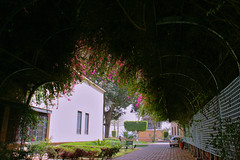
The courtyard and church have a distinctly Arabic feel with intricate wooden carvings, aprons and balconies.
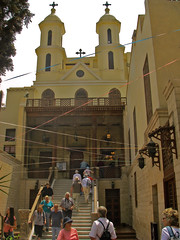
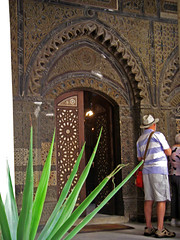
cairo-IMGP0109.JPG
Hanging Church – Courtyard

 cairo-IMGP0111.JPG
Hanging Church – Entrance

 cairo-IMGP0113.JPG
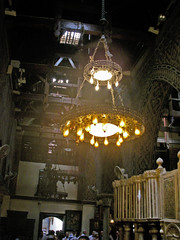
Hanging Church – The Inside

Unlike the Church of St. George, this one is entirely Coptic.

Inside the Church

Inside you can find 110 icons dedicated to the Christian faith most of them dating back to the 18th Century some going back as far as the 8th century, it is said this church is one of the earliest examples of Basilica style architecture.

There are continuous tour groups moving through, although this does little to spoil the over-all atmosphere which is made in the upwards direction;

  • Admire the wooden timber beams which have made up the construct for many centuries.
  • The use of the Basilica Style to bring light into the structure.
  • The ornately structured chandeliers.

all make for a warmth of style in keeping with Arabic, European and Christian decorations and considerations.

A pleasure to be in and around.

Weblinks: The Hanging Church website – Find out more about the hanging church, history and visiting times.

Cairo – Nilometer

KML 30.00745 31.2242

Now you may think this is a corny name, “Nilometer, sounds like mileometer”. But you must remember, the first Nilometer was in existence in Pharoaic times, possibly before Christ not the other way round.
Duhhh.

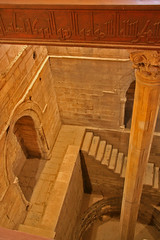
The Nilometer in it’s current incarnation has been measuring the height of the Nile since 751 and the Arabian conquest, at which point they build a special dome and masonry housing and began measuring regularly the height of the Nile each season.

This records have been kept for 14 centuries and have spawned developments in other areas on science, notably Brownian motion for those physicists out there.

Walk on by

I arrived at the Nilometer after a hefty jaunt from the Raddison, I was greeted by the caretaker who invited me and another English family in to take pictures at which point he told us the various facts.

Facts

The Nilometer stands 10.4 meters tall and consists of a cubit, or forearms length x16 measurement units. During the year the water would flow in and out of the chamber rising and falling and being measured.

When the water was particularly high, all the surrounding land would be ruined and the government could take action. Also if the water was low and drought ensued, the government could again, lower taxes to prevent unrest.

There’s a scale:-

http://www.waterhistory.org/

which fiscal decisions for the year could be based.

Explore the shaft

cairo-nilometer
Nilometer Shaft

After this, the caretaker allows us to venture into the musty shaft and explore the damp holes. The shaft has been empty since the building of the Aswan dam.

We all come out smiling :)

Outside the Nilometer

cairo-IMG_1009.JPG

This trip cost 10 EP or £1.

Cairo – Chapel of St. George

KML 30.00552 31.22991

When I arrived in the Old Town area, pretty much everything was closed.

cairo-IMGP0103.JPG
Church of Saint George

After taking a metro into town, which was nearly as hectic as the roads, picking up a map and returning, this was the first place I visited.

The Chapel of St. George is devoted almost entirely to St. George as it’s patron in keeping with Coptic tradition with which seems to have fairly strong ties.

They allow photo’s inside, unusually for an Orthodox church, but there is a caretaker making sure things don’t get out of hand.

cairo-IMGP0107.JPG copy
Church of Saint George

Crypt of St. George

Downstairs is a crypt dedicated entirely to St. George and his dragon slaying abilities, some coloured frescos and stone carvings, stain-glass windows or alter-fronts. Pretty much a shrine to St. George. You are invited to drop a few pennies and help the upkeep of the various George’s and Dragons around the place.

cairo-IMGP0104.JPG
Church of Saint George

Wonder Working Chains

In additional to the normal paraphernalia, the church is kitted out with a 4.2m magical chain. Administered by nuns, it is said that when this chain is attached, it can be a magical cure if venerated and kissed by the patron, with great blessing from George himself.

Particularly mad people and Turks are said to benefit from this most.

Visiting is only on a Friday if you are interested in this particular ceremony.

The church dates back to the 14th Century and has passed between the Roman and Coptic monks.

Cairo – Holy Family Crypt

KML 30.00668 31.22973

The fleeing path of the holy family passed through this spot.

The Holy Family

There are a number of tours explaining the ins and outs of what they got up to.

Basically, when Jesus was born, Herod took it upon himself that the boy had no peace, and pursued the family from Jerusalem, through Jordan into Egypt, where they spent a number of years going from pillar to post.

For those taking it upon themselves, there are tours specially to follow the path of this holy family through Africa and trace the steps of Jesus development and stories.

All interesting stuff.

But, again, since I have no tour I have no information.

Fantastic Shop

There is however, a shop stocking classic furniture and overpriced nic-nacs, similar to the one I came across in X’ian province visiting the terracotta army.
Located in the Crypt of the Holy Family this place was stocked with items you couldn’t find anywhere else, you’d have to pay for items to get shipped over in a crate, but the variety and quality means that everyone passing pays a visit in the hope that they might one day buy something and send it back home.

I have seen a number of these places, some in South America selling one off, expensive, quality items of cultural significance unavailable elsewhere.

Maybe one day I’ll do a Google map with exact locations and share them out.

Until then, here’s just the one.

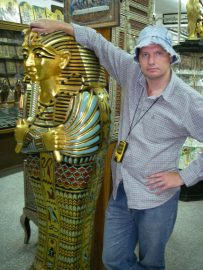
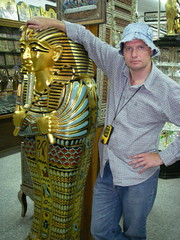
cairo-me michael tyler
Standing next to Mummy

The Pyramids @ Giza

After a morning at the pyramids under my own steam found the experience a bit boring. What you’ll find are four lumps of rock separated by a few hundred yards of desert and the Sphinx and the bottom.
This did little to satisfy my curiosity as to how the pyramids came about.

Come lunch time, I returned to Mena House and hired a tour guide from reception. This would take me through how they came into existence and in turn I can pass some of this on to you.

The site of the Pyramids

There are 2 sites at Giza, the main one and Saqqara.

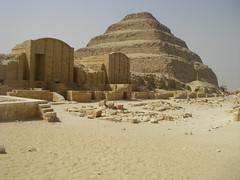
Saqqara Located slightly outside of town. Took a taxi down.

This style of step Pyramid came into existence around 2,600 BC and is based on a mastaba, (mausoleum), construction in a progressive step, each step of diminishing size. This gave early builders the chance to move progressively to the pyramids we know today.

Saqqara – First Democracy

Early courtiers were called to watch the first elections in which the King had to prove he was fit to govern, first by running to and fro across the courtyard 30 times, then requesting the gods that they permit his continued reign. If he failed either of these tests he would not be fit to reign.
Since the gods rarely objected, maintaining power was just a question of proving you were of sound body once in a while.

The temple here was designed by the ancient architect, Imhotep. In terms of artistic development, the styles of the temple imitate those present in nature, which would be familiar, for example; palm branches for ceiling, papyrus for columns. This gives the architecture of feeling of opulence through attaching and bettering natures building materials.

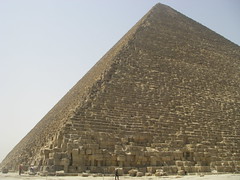
Great Pyramid – Giza

There are 3 main Pyramids at Giza belonging to the 4th Dynasty.

They come in three sizes:

Cheops – 187m

Khafre – 183m

Menkaure – 68m

The pyramids were the worlds tallest structure until the Lincoln Cathedral was built in 1300.

Exploration

Howard Carter was sent to explore the pyramids in 1907, at which point most of them had already been looted.

Legends

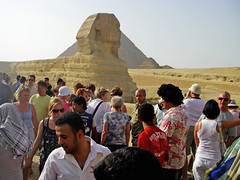
The Sphinx stands at the entrance to the great pyramids and represents a guardian for the the dead kings. It is said that the Thutmosis IV of the 18th Dynasty had a dream of the sphinx telling him to uncover the part-buried structure, and he would be king.

As legend has it, he undertook to remove the desert sand from the structure, and some years later, was crowned King.

Demise

The Pyramids are the oldest stone structures in the world. 

After the 4th dynasty, pyramid building became less.

Photo’s

pyramids-giza-IMGP0096.JPG
Great Pyramid – Giza

Sphinx
Sphinx – Giza

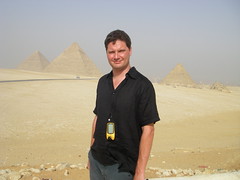
pyramids-giza-
Pyramid Complex – Giza

pyramids Saqqara
Saqqara