Not to be mist, this captures around and hour just after 6.
Tour
In English, a narration is boomed out from speakers as you are guided around the ancient ruins at Karnak.
Spooky lightshow
Coloured lights Illuminate the various columns, hieroglyphics, plus spooky music adds atmosphere to help describe what it was that made Thebes (Luxor) the great and successful beating heart of the nation.
It’s not to heavy, more honest than a BBC documentary, brings you back to the days of Carter and the good old British Empire. (Horahh for Blighty!).
After Cairo, I was pleased that this was a museum in a traditional sense, in that you might find things of interest and read the little cards they left out.
The museum was encapsulated in three levels, with an introductory video talking about the Egyptian Golden era.
The Golden Era Spanning from 3400 BC to 39AD.
During this period, Egyptians who had once lived near to the Nile were forced, by climate change, to move nearer the flood plains and formed the first communities. Initially farming, then centres of trading, particularly around Buto in the North.
The development of Writing, allowed passing of ideas or knowledge through hieroglyphics spreading the advancement of technology; Technology:- Long Bows, Chariots, Calendar, Masonry, Construction, Planning, Specialisation of Labour to mention a few..
A nation united
Through military conquest in upper Egypt, the Hyksos tribe were forced from the delta areas around Giza. Whilst in the south the Nubian tribes were defeated during the reign of Mentuhotep and Amenhotep, who, (latterly), was a particularly fierce and renowned warrior king.
Eventually two kingdoms of north and south Nile were consolidated leading to 3450 years of dominance creating a civilisation to be envied by the world.
The Museum
Goes some way to explaining the customs and warfare, particularly.
Again, surprise surprise, you’re going to need a guide to gain anything from this museum. One approached me outside and offers to take me round for £15 for 1 and 1/2 hours, £10 per hour.
The thought does cross my mind, so I offer to hang around for more visitors to bring the price lower, at which point he tells me the price will not lower he’ll charge us all the same which could equate to £70-80 per hour. Another example of money-grabbing by the Egyptians, and this guy actually worked for the museum so goes some way to indicating the attitude toward tourism.
Inside the Museum
Once inside the museum is a large circular atrium surrounded by a large rectangle filled with statues and relics.
Photo’s are not allowed.
Heavy statues are on the ground floor artifacts and jewellery are on the second floor.
Left wondering
I spend long enough wondering round to realise you’re really going to gain nothing without a guide, most of the pieces are labelled without dates, dynasties, locations or any over-riding narrative, story-board or reason d’etre.
This is a shame. As a visitor, I feel that I really gained nothing from the experience. Apart from feeling that the Egyptians were by far the most advanced civilisation and way ahead of their time, which I felt when I walked in, this museum has been tiring and slightly pointless.
This was opposed to the Coptic Museum which was interesting and informative with over-riding structure and narrative. The aim of this museum seems to be to grab money rather than to educate.
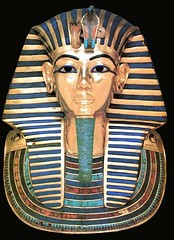
Here’s a couple of pictures of what makes the museum famous.
Face Mask of King TUT
Gold Sarcophagus.
If you feel you should visit, you’re going to need a guide (again).
It’s worth the entrance fee but not the time. You could spend hours and learn nothing.
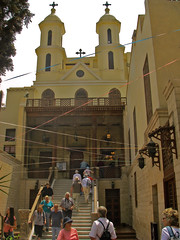
Called the hanging Church because it was once positioned over the gatehouse to the Coptic quarters.
Oldest Church
The Coptic hanging church is the oldest church I have visited, dating back to the 7th century. Some parts of the church have been carbon dated, the most recent revealing first construction around 2nd century BC. It’s clear this church has been around in some form for a very long time.
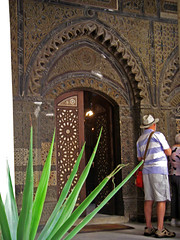
The courtyard and church have a distinctly Arabic feel with intricate wooden carvings, aprons and balconies.
Unlike the Church of St. George, this one is entirely Coptic.
Inside the Church
Inside you can find 110 icons dedicated to the Christian faith most of them dating back to the 18th Century some going back as far as the 8th century, it is said this church is one of the earliest examples of Basilica style architecture.
There are continuous tour groups moving through, although this does little to spoil the over-all atmosphere which is made in the upwards direction;
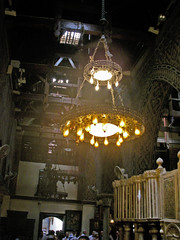
Admire the wooden timber beams which have made up the construct for many centuries.
The use of the Basilica Style to bring light into the structure.
The ornately structured chandeliers.
all make for a warmth of style in keeping with Arabic, European and Christian decorations and considerations.
A pleasure to be in and around.
Weblinks: The Hanging Church website – Find out more about the hanging church, history and visiting times.
We use cookies on our website to give you the most relevant experience by remembering your preferences and repeat visits. By clicking “Accept All”, you consent to the use of ALL the cookies. However, you may visit "Cookie Settings" to provide a controlled consent.
This website uses cookies to improve your experience while you navigate through the website. Out of these, the cookies that are categorized as necessary are stored on your browser as they are essential for the working of basic functionalities of the website. We also use third-party cookies that help us analyze and understand how you use this website. These cookies will be stored in your browser only with your consent. You also have the option to opt-out of these cookies. But opting out of some of these cookies may affect your browsing experience.
Necessary cookies are absolutely essential for the website to function properly. These cookies ensure basic functionalities and security features of the website, anonymously.
Cookie
Duration
Description
cookielawinfo-checkbox-analytics
11 months
This cookie is set by GDPR Cookie Consent plugin. The cookie is used to store the user consent for the cookies in the category "Analytics".
cookielawinfo-checkbox-functional
11 months
The cookie is set by GDPR cookie consent to record the user consent for the cookies in the category "Functional".
cookielawinfo-checkbox-necessary
11 months
This cookie is set by GDPR Cookie Consent plugin. The cookies is used to store the user consent for the cookies in the category "Necessary".
cookielawinfo-checkbox-others
11 months
This cookie is set by GDPR Cookie Consent plugin. The cookie is used to store the user consent for the cookies in the category "Other.
cookielawinfo-checkbox-performance
11 months
This cookie is set by GDPR Cookie Consent plugin. The cookie is used to store the user consent for the cookies in the category "Performance".
viewed_cookie_policy
11 months
The cookie is set by the GDPR Cookie Consent plugin and is used to store whether or not user has consented to the use of cookies. It does not store any personal data.
Functional cookies help to perform certain functionalities like sharing the content of the website on social media platforms, collect feedbacks, and other third-party features.
Performance cookies are used to understand and analyze the key performance indexes of the website which helps in delivering a better user experience for the visitors.
Analytical cookies are used to understand how visitors interact with the website. These cookies help provide information on metrics the number of visitors, bounce rate, traffic source, etc.
Advertisement cookies are used to provide visitors with relevant ads and marketing campaigns. These cookies track visitors across websites and collect information to provide customized ads.