
The world’s smallest bible, printed on a silicon chip the size of a grain of sugar. (photo courtesy of The Israel Museum, Jerusalem) JTA — You’ve never seen the Bible like this before. That is, if you can actually see this version. For the 50 th anniversary of the Shrine of the Book wing of the… Continue reading “Israel Museum displays world’s tiniest bible”
Month: April 2015
3.3 million new investors sign up to for China’s dicey stock market in the last week
The surging stock markets in both mainland China and Hong Kong in recent weeks have drawn plenty of people to suggest that, when something rises so fast, it can only end badly. If the sheer volume of eager traders is anything to go by, Chinese stocks are unlikely to return to normality any time soon.
Last week, 3.3 million people in China opened new brokerage accounts to buy “A-shares,” as Chinese mainland-listed stocks are called, according to the China Securities Depository and Clearing Company.
That brings the number of people able to buy and sell shares in Shanghai, Shenzhen, and—thanks to a recent Shanghai-Hong Kong hook-up—Hong Kong, to almost 200 million.
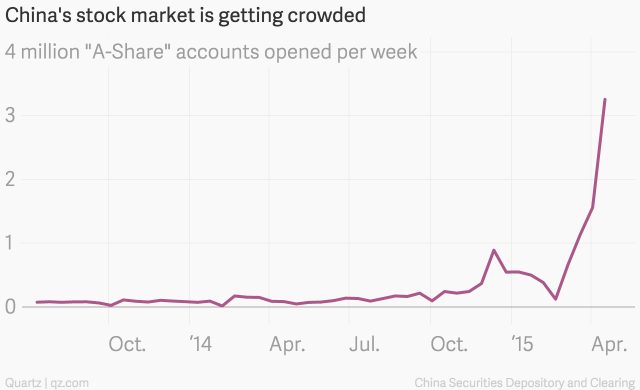
Over the past two years, signups averaged fewer than 300,000 per week. Even at the height of China’s last bull market, in 2007, the most weekly signups was still only half last week’s volume.
Source: QZ
Related articles


The top 10 most censored countries in the World
I’ve lived in one of these countries (China), and visited two (Vietnam, Cuba).
Censorship is an accepted way of life, in my experience, residents take care not to get caught, and are usually quite careful about what they say to foreigners they don’t know.
In that sense, I’ve found it easy just to roll through these countries and pretend that everyone is happy and content.
Often, the reason you get that impression is, the censorship is working.
The great wall of China
They’ve notched the wall up. It’s significantly more difficult to access the ‘net. There’s an article I did on that here.
Article taken from: Committee to Protect Journalists
Repressive nations threaten jail terms, restrict Internet to silence press
Eritrea and North Korea are the first and second most censored countries worldwide, according to a list compiled by the Committee to Protect Journalists of the 10 countries where the press is most restricted. The list is based on research into the use of tactics ranging from imprisonment and repressive laws to harassment of journalists and restrictions on Internet access.
In Eritrea, President Isaias Afewerki has succeeded in his campaign to crush independent journalism, creating a media climate so oppressive that even reporters for state-run news outlets live in constant fear of arrest. The threat of imprisonment has led many journalists to choose exile rather than risk arrest. Eritrea is Africa’s worst jailer of journalists, with at least 23 behind bars-none of whom has been tried in court or even charged with a crime.
Fearing the spread of Arab Spring uprisings, Eritrea scrapped plans in 2011 to provide mobile Internet for its citizens, limiting the possibility of access to independent information. Although Internet is available, it is through slow dial-up connections, and fewer than 1 percent of the population goes online, according to U.N. International Telecommunication Union figures. Eritrea also has the lowest figure globally of cell phone users, with just 5.6 percent of the population owning one.
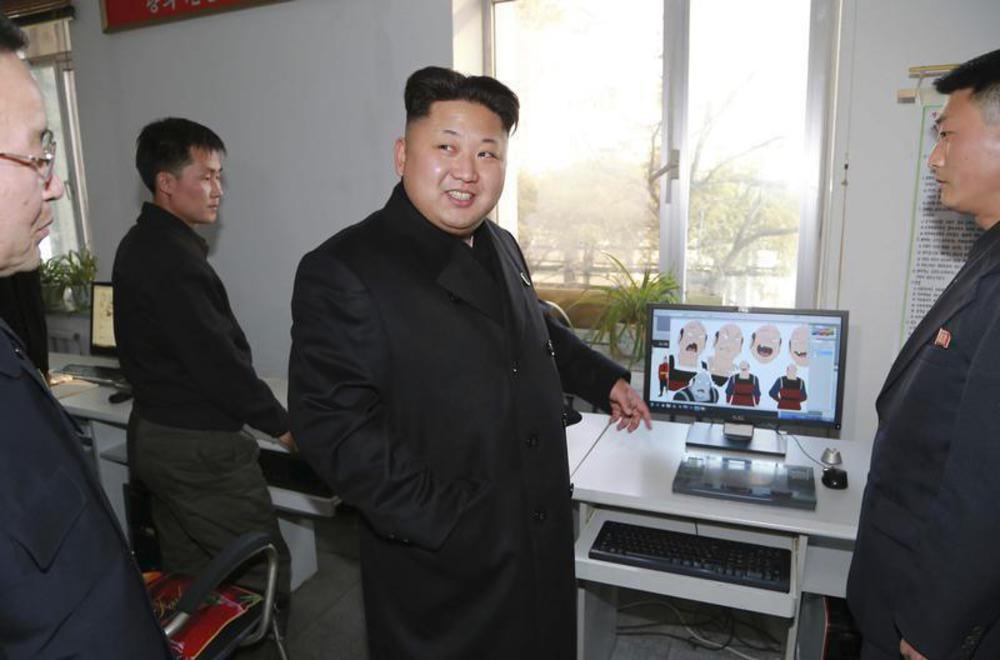
In North Korea, 9.7 percent of the population has cell phones, a number that excludes access to phones smuggled in from China. In place of the global Internet, to which only a select few powerful individuals have access, some schools and other institutions have access to a tightly controlled intranet. And despite the arrival of an Associated Press bureau in Pyongyang in 2012, the state has such a tight grip on the news agenda that newsreel was re-edited to remove Kim Jong Un’s disgraced uncle from the archives after his execution.
The tactics used by Eritrea and North Korea are mirrored to varying degrees in other heavily censored countries. To keep their grip on power, repressive regimes use a combination of media monopoly, harassment, spying, threats of journalist imprisonment, and restriction of journalists’ entry into or movements within their countries.
Imprisonment is the most effective form of intimidation and harassment used against journalists.
Seven of the 10 most censored countries-Eritrea, Ethiopia, Azerbaijan, Vietnam, Iran, China, and Myanmar-are also among the top 10 worst jailers of journalists worldwide, according to CPJ’s annual prison census.
More than half of the journalists imprisoned globally are charged with anti-state crimes, including in China, the world’s worst jailer and the eighth most censored country. Of the 44 journalists imprisoned-the largest figure for China since CPJ began its annual census in 1990-29 were held on anti-state charges. Other countries that use the charge to crush critical voices include Saudi Arabia (third most censored), where the ruling monarchy, not satisfied with silencing domestic dissent, teamed up with other governments in the Gulf Cooperation Council to ensure that criticism of leadership in any member state is dealt with severely.
In Ethiopia–number four on CPJ’s most censored list–the threat of imprisonment has contributed to a steep increase in the number of journalist exiles. Amid a broad crackdown on bloggers and independent publications in 2014, more than 30 journalists were forced to flee, CPJ research shows. Ethiopia’s 2009 anti-terrorism law, which criminalizes any reporting that authorities deem to “encourage” or “provide moral support” to banned groups, has been levied against many of the 17 journalists in jail there. Vietnam (sixth most censored) uses a vague law against “abusing democratic freedom” to jail bloggers, and Myanmar (ninth most censored) relies on its 1923 Official Secrets Act to prevent critical reporting on its military.
Internet access is highly restricted in countries under Communist Party rule-North Korea, Vietnam, China, and Cuba.
In Cuba (10th most censored), the Internet is available to only a small portion of the population, despite outside investment to bring the country online. China, despite having hundreds of millions of Internet users, maintains the “Great Firewall,” a sophisticated blend of human censors and technological tools, to block critical websites and rein in social media.
In countries with advanced technology such as China, Internet restrictions are combined with the threat of imprisonment to ensure that critical voices cannot gain leverage online. Thirty-two of China’s 44 jailed journalists worked online.
In Azerbaijan (fifth most censored), where there is little independent traditional media, criminal defamation laws have been extended to social media and carry a six-month prison sentence. Iran, the seventh most censored country, has one of the toughest Internet censorship regimes worldwide, with millions of websites blocked; it is also the second worst jailer of journalists, with 30 behind bars. Authorities there are suspected of setting up fake versions of popular sites and search engines as part of surveillance techniques.
Government harassment is a tactic used in at least five of the most censored countries, including Azerbaijan, where offices have been raided, advertisers threatened, and retaliatory charges such as drug possession levied against journalists. In Vietnam, many bloggers are put under surveillance in an attempt to prevent them from attending and reporting on news events. In Iran, journalists’ relatives have been summoned by authorities and told that they could lose their jobs and pensions because of the journalists’ work. And in Cuba, which has made some progress, including resuming diplomatic relations with the U.S. and proposing an end to Castro rule by 2018, the few independent journalists trying to report in the country are still subject to harassment and short-term detention.
Restricting journalists’ movements and barring foreign correspondents is also a common tactic used by censoring governments. In Eritrea, the last remaining accredited international reporter was expelled in 2007, and the few outside reporters invited in occasionally to interview the president are closely monitored; in China, foreign correspondents have been subjected to arbitrary delays in visa applications.
Four heavily censored nations that nearly made the list are Belarus, Equatorial Guinea, Uzbekistan, and Turkmenistan, all of which have little to no independent media and are so tightly closed that it can be difficult even to get information about conditions for journalists.
The list of most censored countries addresses only those where government tightly controls the media. In some countries, notably Syria, conditions are extremely dangerous and journalists have been abducted, held captive, and killed, some by forces loyal to President Bashar al-Assad but also by militant groups such as the Islamic State.
Continue reading “The top 10 most censored countries in the World”
Place your bets – The AIIB, the stock market and China’s Geo-politcal future
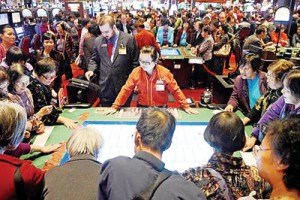 Given the Chinese penchant for gambling, (it’s illegal apart from in Macau), punting one’s investments into the only free gambling machine on the mainland seems like the natural thing to do.
China has its own new gambling machine. It’s called the stock market.
For the past twelve months, the Shanghai Composite has risen by 100%, and from 3,000 to 4,000 points since February, mostly brought on by domestic demand.
China’s New investors
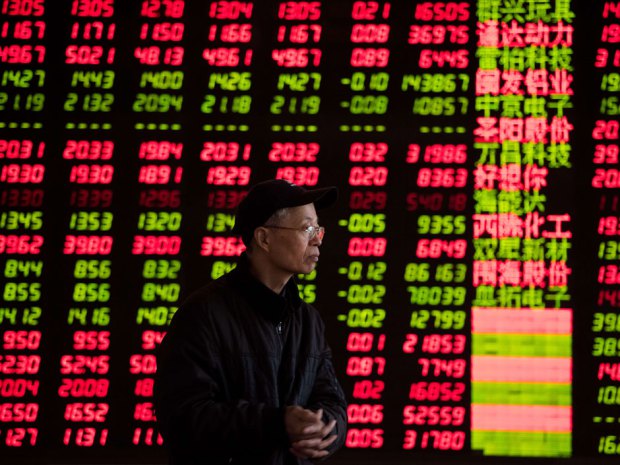 Bloomberg Business – “Gan’s survey, which was conducted at the end of 2014 and covers some 4,000 households across the country, finds that the biggest new investors in China’s equity markets have below a high school education and relatively low levels of asset ownership.”
Small and medium size investors are getting into shares for the first time. And these new investors are not high flying whizz kids from the city, more likely, according to this research non-savvy, non-educated aunts and uncles jumping on for a free ride to high returns.
As the property market has become less attractive, with Xi Jinping’s increased anti-corruption measures and oversupply in the market, who can blame them? Continue reading “Place your bets – The AIIB, the stock market and China’s Geo-politcal future”
US moves operations to EMP-proof bunker
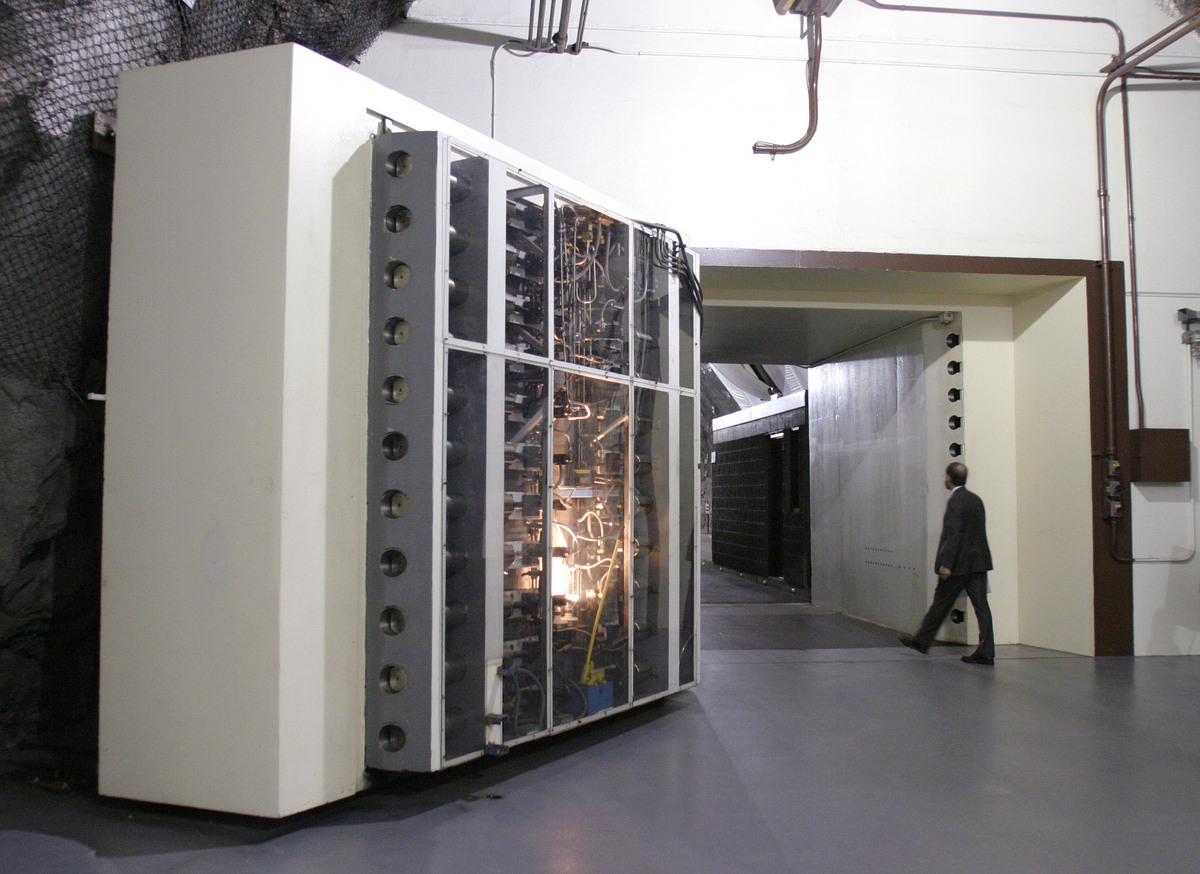
People talk about traditional nukes’ when it’s fairly well known the modern threat is from what’s known as EMP, or Electromagnetic Pulse.
Both Russia and China have plans in place focusing on the use of these weapons and on knocking the backbone out of the technical infrastructure in the event of any conflict.
Having said that, it’s interesting to read this article on how the US has taken a step BACKWARDS moving it’s Aviation defense to a 1960’s style cold war bunker.
NEW YORK — One of America’s most potent symbols of the Cold War is to re-open more than a decade after it was abandoned. Cheyenne Mountain, the subterranean bunker and command centre built beneath Colorado’s Rocky Mountains, is being refurbished by the Pentagon to provide protection for America’s modern defense systems that could be targeted by an electromagnetic pulse attack.
Peterson Airbase
The complex was closed in 2006 after the government deemed Russia to no longer be a threat, with NORAD, the North American Aerospace Command, moved to the nearby Peterson Air Force Base. NORAD was housed within the mountain for much of the bi-polar standoff, the organisation’s systems scanning the skies for sign of an impending Soviet nuclear attack.
Cheyenne Mountain
Earlier this week, officials announced that sensitive communications equipment for the US military would be moved to the complex in a $700 million refit to protect it from EMP. “Because of the very nature of the way that Cheyenne Mountain’s built, it’s EMP-hardened,” said US Northern Command Admiral William Gortney.
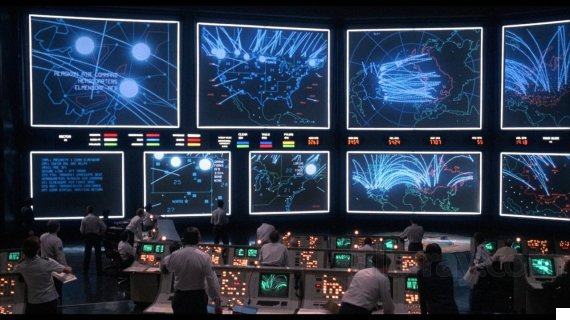
The bunker was created in the Sixties, workmen carving a huge hole in the mountain designed to withstand a 30-megaton nuclear attack. The complex has featured several times in popular culture, most notably in the 1983 film “War Games”. Continue reading “US moves operations to EMP-proof bunker”